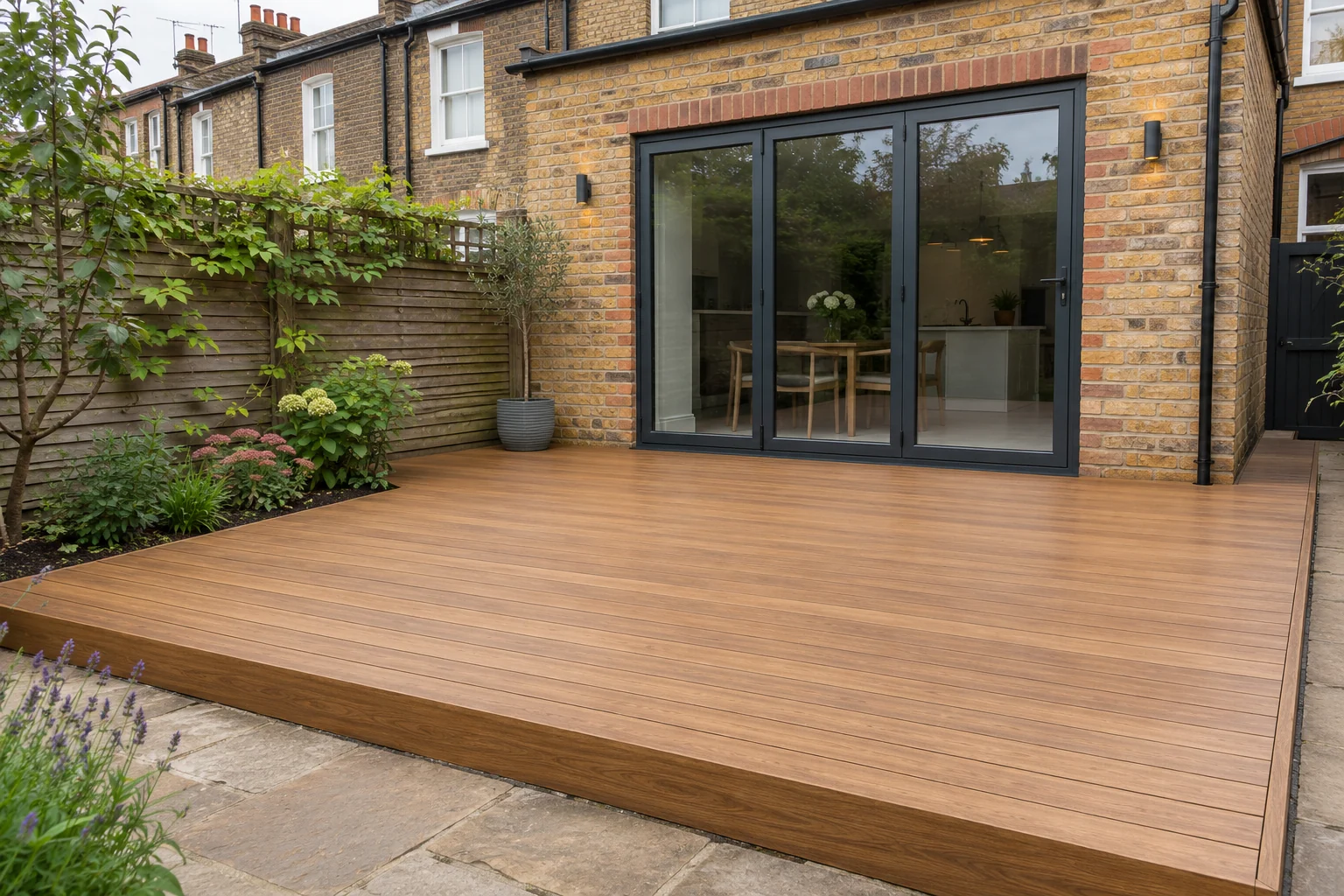
The short answer. 28mm is a sensible starting point for pressure-treated softwood on a typical UK garden deck. Some hardwood decking comes in 19mm or 21mm profiles. Composite boards around 20–25mm are easy to find, and some systems are thicker. Choose the exact board alongside its joist-spacing requirements and the height you have available. Wickes timber decking · Balau hardwood board sizes · Dino composite sizes · Trex UK installation guide
Decking thickness in mm: timber and composite compared
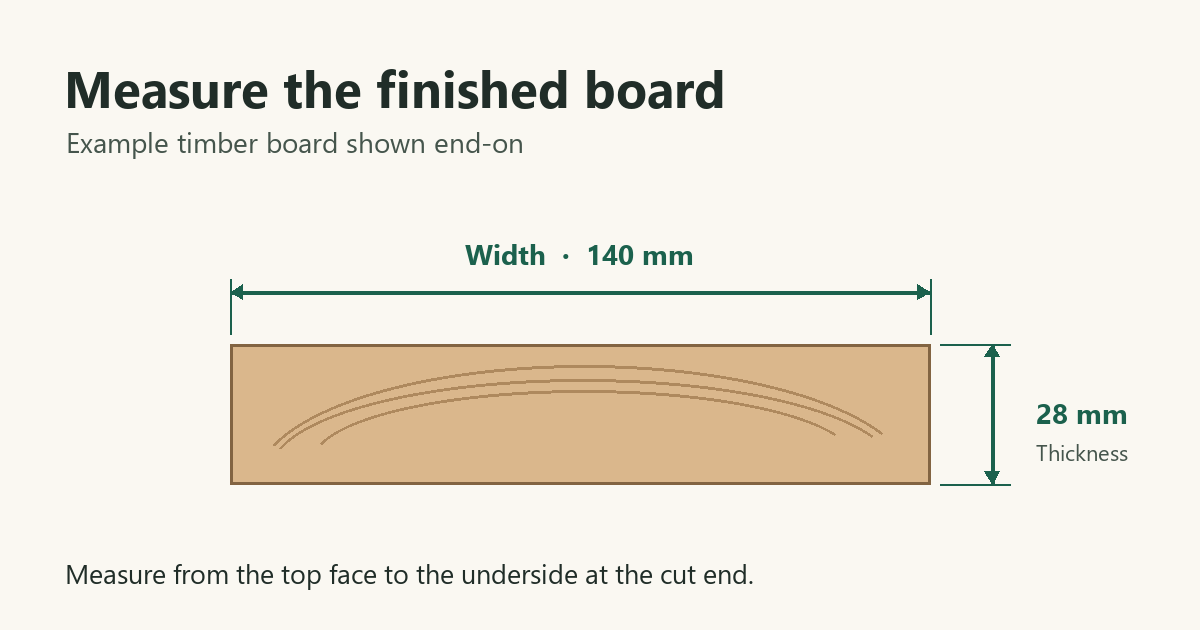
Deck board thickness is the depth from the top face to the underside. When you see a size such as 28 × 140mm on a timber listing, that usually means 28mm thick and 140mm wide. Suppliers can list dimensions in a different order, so look for the labelled width and thickness in the specification.
| UK board example | Finished thickness | Width | What to check before buying |
|---|---|---|---|
| Wickes standard treated softwood | 25mm | 120mm | Check the board’s support requirements against your layout. |
| Typical treated softwood size | 28mm | 140mm | A useful size to compare quotes for a domestic timber deck. |
| Balau hardwood, smooth profile | 21mm | 145mm | Confirm the permitted joist centres and compatible fixings. |
| Dino Classic composite | 21mm | 145mm | Dino’s fitting guide specifies joist centres of no more than 300mm. |
| Trex 25mm grooved-edge composite | 25mm | 140mm | Use the span and fixing guidance for the exact board and layout. |
| Millboard Enhanced Grain Smoked Oak | 32mm | 176mm | A resin and mineral composite. Allow for the extra depth in the build-up. |
Wickes product specifications · Wickes timber size guide · Balau hardwood board sizes · Dino product catalogue · Dino fitting guide · Trex UK installation guide · Millboard product specification
Timber decking thickness: is 28mm a good choice for softwood?
For a domestic garden deck, 28mm pressure-treated softwood is a practical starting point. A 25mm board can also suit a project with the right support. The Timber Decking and Cladding Association (TDCA) lists timber deck boards from 19mm to 45mm across the market. That range includes different species and profiles, so check the span guidance for the board you’re considering before you set out the joists. TDCA timber deck board options · TDCA timber decking handbook Explore our softwood and hardwood decking options.
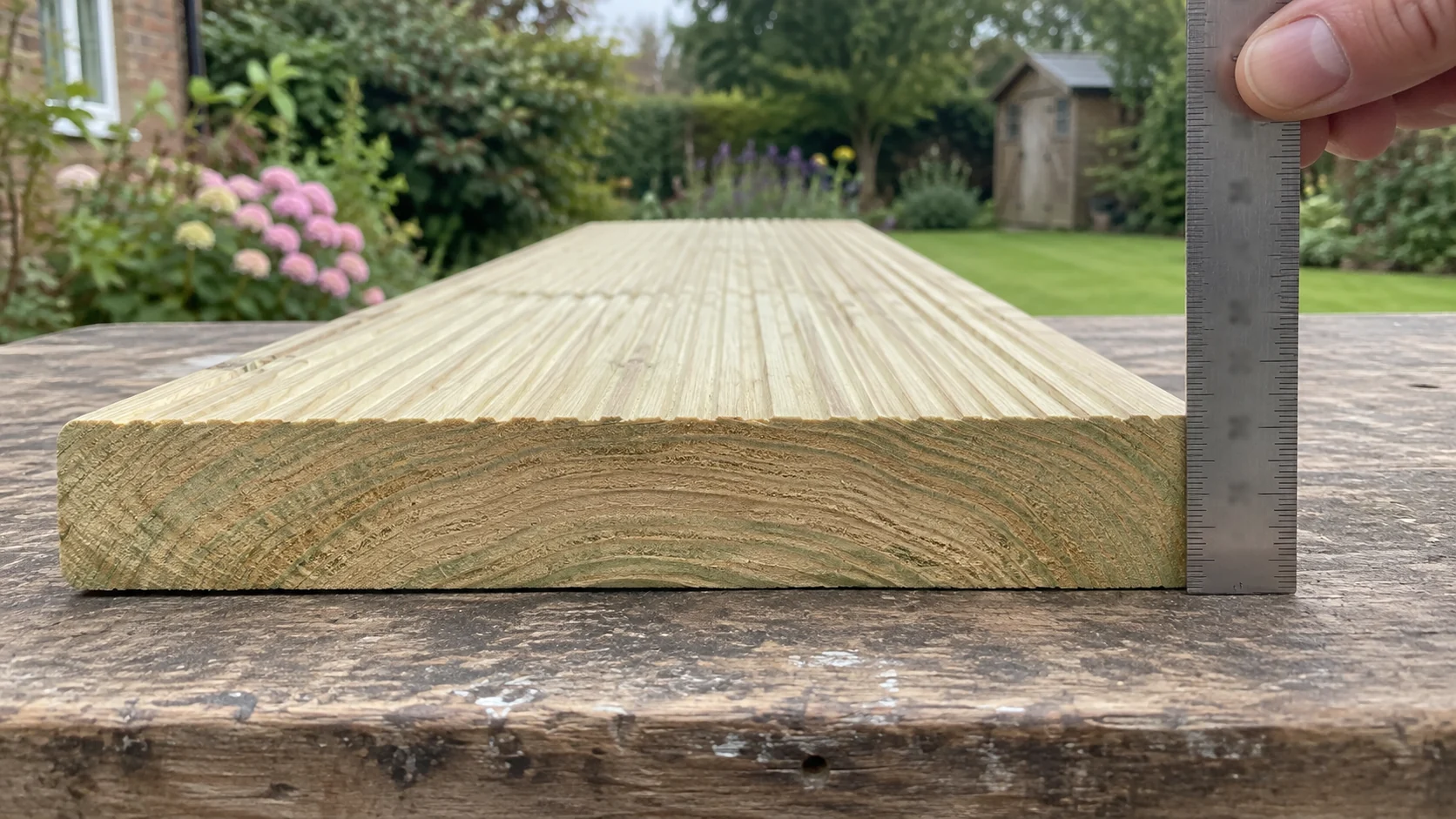
Ask for the finished thickness. If a merchant gives you a nominal size, ask what the board measures after machining. For a replacement, lift a sound board and measure its full depth at the cut end. Measure the width too, and check the groove pattern and fixing position. A 32mm board on the same supports as a 28mm board will sit 4mm higher, enough to leave a lip beside the old boards.
Hardwood decking thickness: are thinner boards suitable?
UK suppliers offer hardwood decking in sizes such as 19 × 90mm and 21 × 145mm in Balau. A thinner hardwood board can be a good option where the finished deck height is tight. Ask the supplier for the maximum joist centres for that species, profile and board direction before ordering, especially if you’re reusing an existing frame. Balau hardwood board sizes · TDCA timber decking handbook
Replacing 28mm softwood with 21mm hardwood? On the same supports, the new surface will sit 7mm lower. If you replace only part of the deck, that leaves a step between old and new boards. For a full replacement, check how the new height will meet steps, paving and the door threshold. Ask whether the quote includes any changes to the joists or edging.
For face-fixed hardwood, pre-drill the screw holes to reduce splitting and use corrosion-resistant fixings approved for the timber. Ask what gap the supplier specifies between boards. Hardwood still moves with changes in moisture, and the gaps help rainwater drain away. TDCA guidance on decking fixings · TDCA timber decking specification
Composite decking thickness: how much does the profile matter?
The thickness of composite decking is only one part of the specification. Two boards of the same depth can have different cores, profiles and fixing systems. Check the maximum joist centres, the clips or screws specified, and the requirements for end gaps and joints. The Dino fitting guide, for example, calls for two joists at a butt joint so each board end has its own support and fixing. Dino composite decking thickness guide · Dino fitting guide
If you’re replacing timber with composite, take a sample board and its fixing system to the deck before ordering. Check how the board will meet the steps, edging and patio doors. A thinner surface board may buy you a few millimetres, while the required joists, supports and drainage still determine the overall build-up. See our composite decking installation service or compare the long-term costs of timber and composite.
Deck board thickness and joist spacing: why does my deck bounce?
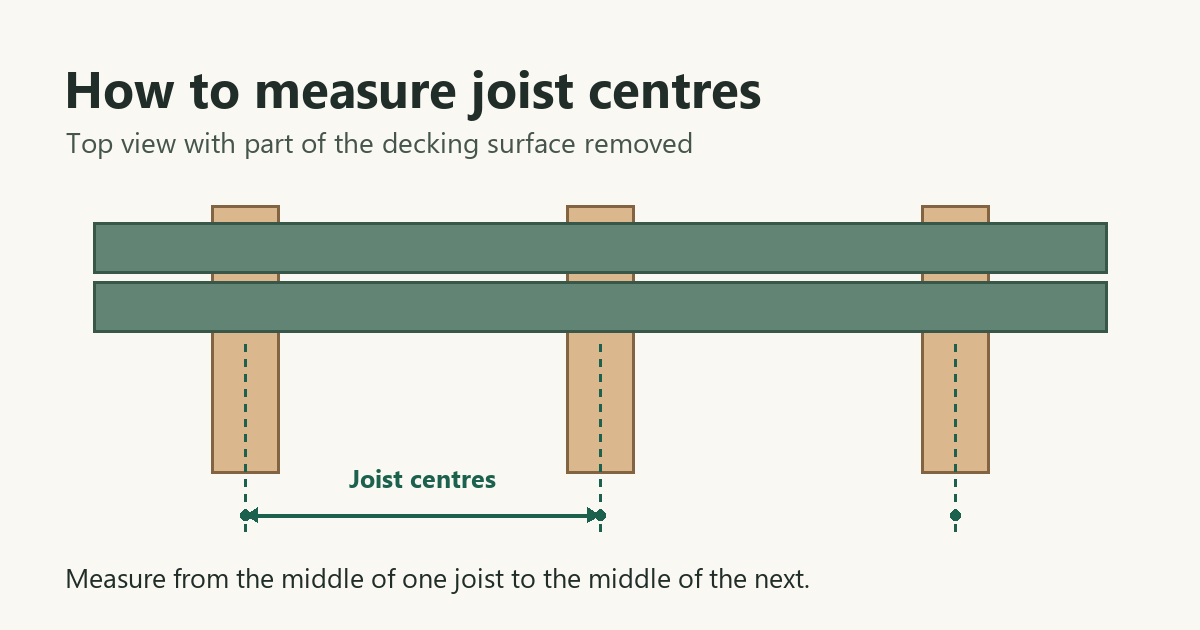
Joist centres are measured from the middle of one joist to the middle of the next. Measure several gaps, especially near board ends and along the edges. If a board dips between joists, check the spacing and the board’s condition. If several boards move together, the frame or its supports may be moving. Loose fixings, deteriorated timber and unsupported joints are worth checking before you pay for thicker boards. TDCA timber decking handbook
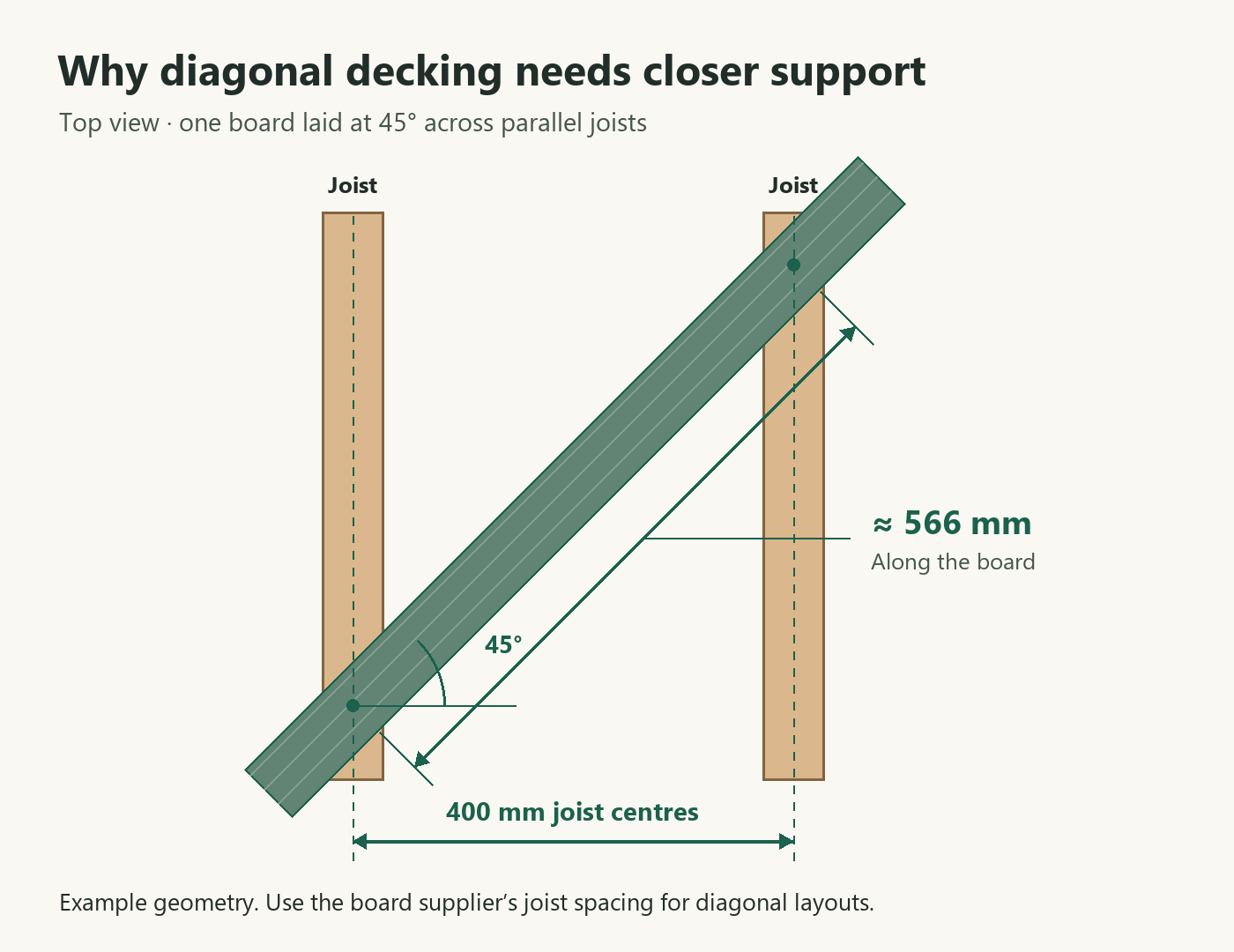
Say your old timber frame has joists at 400mm centres and the composite you want permits 300mm maximum. The frame needs to be altered to suit that board, or you can choose a compatible board if the frame is sound. Diagonal layouts can also need closer joists because the boards travel further between supports. With joists at 400mm centres, a board laid at 45° spans about 566mm along its length between joist centrelines. Use the manufacturer’s spacing for the layout you plan to install. Dino fitting guide · Cladco layout guidance
Decking width: how wide should your boards be?
Decking width changes how many rows you need and how the last row will finish. A 120mm board gives you more visible joints than a 145mm board over the same area. For timber, the TDCA advises against boards wider than 150mm to help with drainage and limit the effects of moisture movement. Proprietary composite systems can come in wider profiles, such as the 176mm Millboard example above. TDCA timber deck board options · Millboard Enhanced Grain
When setting out the deck, count the gaps as well as the boards. Ten 140mm boards with nine 6mm gaps cover 1,454mm, before any perimeter clearance. The 6mm is an example. Use the gap specified for your boards and check the width left for the final row before fixing the first one.
Ready to work out quantities? Use our decking calculator to estimate boards, joists and fixings for rectangular, L-shaped or custom decks.
Thickness of decking boards near patio doors and steps
Measure from the proposed support level to the intended finished deck surface. Check the door swing if the doors open outwards, the threshold drainage and how the deck will meet existing steps or paving. Allow for the whole assembly, including any pedestals or bearers, the joists and the boards. Keep drainage and ventilation routes clear and check the detail where decking meets the house so the damp-proof course is protected. TDCA guidance on decking beside a house
When comparing quotes, ask each installer to show the finished deck height at the door and confirm whether the price includes changes to the subframe. That makes it easier to see what’s included before work starts. If the design involves a significant change in level, see our raised decking and balcony installations.
What is the best thickness for deck boards?
- For a new timber garden deck, start by comparing 28mm treated softwood boards. Confirm the joist layout for the product and check that the finished height works.
- For hardwood decking, compare the supplier’s finished board sizes and check the permitted joist spacing, fixing method and finished deck height.
- For a new composite deck, choose the product and board direction before setting out the frame. Ask for the maximum joist centres in writing.
- For replacing a few boards, match the measured thickness, width and profile, and check that the support underneath is sound.
- For a raised deck, balcony or hot tub, get the supporting structure assessed for the intended load. A thicker surface board alone cannot establish what the structure can carry. TDCA timber decking handbook
Planning a new timber or composite deck, or a full replacement in London? Get a free quote from London Decking Specialists. If you’re replacing a deck, a photo of the patio door threshold and any visible joists will help us understand the existing layout before a visit.