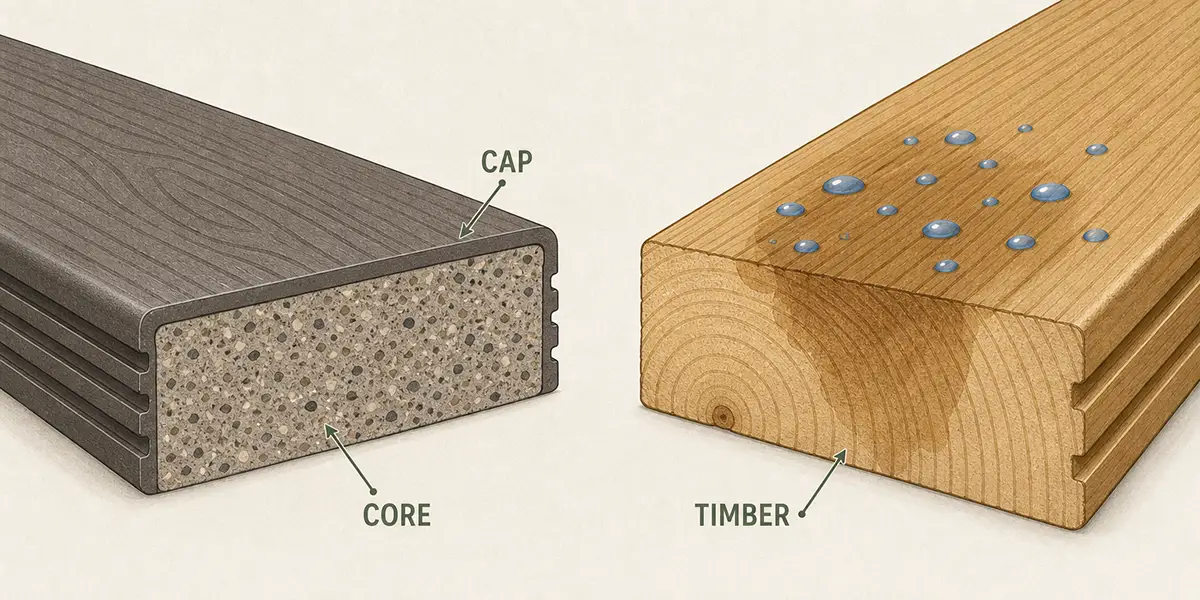
The catch is that those figures only apply to the boards. What actually determines how long your deck lasts is usually what sits underneath them. This guide covers the real lifespans of composite, timber and so-called resin decking, what the warranties do and do not promise, and the one mistake that quietly halves the life of otherwise excellent decking.
How long does composite decking last?
A well-installed composite deck should last 25 to 30 years, and high-quality capped composite boards can exceed that. UK manufacturers put their warranties where those claims are:
- Eurocell guarantees its composite decking for 20 years, with its solid Pathway boards carrying a 25-year guarantee (Eurocell)
- Ecoscape offers a 20-year warranty on its Clarity range and 25 years on its capped Forma range (Ecoscape)
- Trex warranties run from 25 years up to 50 years depending on the product line (Trex warranty document)
Composite lasts this long because the wood fibres in the boards are encased in plastic. That barrier stops the two things that kill timber decking: water getting into the wood, and the rot and insect attack that follow.
Two caveats apply. First, warranties are conditional. Install the boards outside the manufacturer’s guidelines and the warranty is void, and that includes using the wrong fixings. Second, “composite” covers a wide quality range. Cheap uncapped hollow boards, premium capped solid boards and wood-free resin mineral boards such as Millboard are different products at different price points, and they will not age the same way.
How long does wooden decking last?
Softwood decking in the UK typically lasts 10 to 15 years. Hardwood decking lasts longer, commonly 20 to 25 years when properly maintained.
Three factors decide where in that range a timber deck lands:
- Treatment and maintenance. Softwood needs re-oiling, staining or sealing regularly, in practice every 1 to 2 years. Skip it and the lifespan drops fast.
- Timber grade. Pressure-treated softwood rated for outdoor structural use lasts far longer than untreated or lightly treated boards.
- Drainage and ventilation. Timber that stays wet rots. Decks built close to the ground with poor airflow fail years earlier than well-ventilated ones.
Hardwoods such as oak, and tropical species such as ipe and teak, resist rot naturally and can outlast some composites. They also cost considerably more and still need periodic oiling to keep their colour.
How long does Trex decking last?
Trex, the biggest composite decking brand, warranties its boards for 25 to 50 years for residential use depending on the line. According to Trex’s published warranty terms, the Signature and Transcend ranges carry a 50-year limited residential warranty, Select carries 35 years, and Enhance carries 25 years (Trex). Commercial installations are warranted for 10 years across most lines.
Those warranties cover material defects, splitting, splintering, rot and structural damage from insect or fungal attack, plus a separate fade and stain warranty on capped lines. They do not cover poor installation, and the residential warranty can only be transferred to a new owner once, within five years of purchase.
A warranty is not the same as a lifespan. But a manufacturer committing to 50 years in writing is a reasonable signal of how long a capped composite board lasts when installed correctly.
What is resin decking and how long does it last?
“Resin decking” can mean three different products, and they age very differently:
- Resin mineral composite boards, the accurate use of the term. Millboard, the best-known UK brand, makes boards from polyurethane resin and mineral stone with a fibreglass-reinforced core and no wood content at all (Millboard). With nothing organic in the board, there is nothing to rot, swell or attract insects. Millboard backs this with a 25-year limited structural residential warranty, and the boards are expected to last 30 years or more. It sits at the premium end of the market and is priced accordingly.
- Wood plastic composite boards, often loosely called resin decking because the wood fibres are bound in plastic. If this is what a supplier means, the lifespan is the 25 to 30 years covered above.
- Resin-bound surfacing, where aggregate stones are mixed with resin and trowelled over a solid base. This is a patio and driveway product, not decking. It typically lasts 15 to 25 years, but it needs a rigid base underneath, so it is not an option for a raised or balcony deck.
If you are comparing “resin decking” quotes, check which product is actually being offered. A wood-free resin mineral board, a wood plastic composite and a trowelled resin surface are three different products at three different price points.
Composite decking vs wood: lifespan compared
Here is how the materials compare on lifespan and upkeep. Figures are typical UK ranges and assume correct installation.
| Material | Typical lifespan | Typical warranty | Maintenance required |
|---|---|---|---|
| Softwood timber | 10 to 15 years | 5 to 15 years (treatment-dependent) | Re-oil or stain every 1 to 2 years |
| Hardwood timber | 20 to 25 years | Varies by supplier | Periodic oiling and cleaning |
| Uncapped composite | 15 to 25 years | Around 20 years | Wash once or twice a year |
| Capped composite | 25 to 30+ years | 25 to 50 years | Wash once or twice a year |
| Resin mineral composite (e.g. Millboard) | 30+ years | 25 years structural | Wash once or twice a year |
Lifespan is only half the comparison. Timber costs less upfront, composite costs less to keep. We have covered the full numbers in our composite vs timber decking cost comparison, which works through what each material actually costs over 15 years including maintenance.
What shortens the life of a deck?
The most common reason a deck fails early is the subframe, not the boards. Every lifespan figure above assumes the structure underneath is sound. In practice, plenty of composite decks with 25-year board warranties are installed on untreated or under-specified softwood joists that will rot in 10 to 15 years. When the subframe goes, the deck goes with it, regardless of what the boards were rated for.
The other early killers are:
- Ground contact and poor drainage. Joists sitting on or near wet ground, with no membrane or pedestals, stay damp and rot from below.
- Missing expansion gaps. Composite boards expand and contract with temperature. Boards fitted tight to each other warp, lift and crack.
- Wrong fixings.Standard screws instead of the manufacturer’s hidden fixing system can split boards and void the warranty.
- Trapped debris. Leaves and dirt blocking the gaps hold moisture against the boards and the frame.
This is why the survey stage matters more than the board brochure. When we design a deck, the subframe is specified to match or outlast the boards on top of it, whether that means treated C24 timber, composite joists or aluminium. A 25-year board on a 10-year frame is a 10-year deck.
How can you make decking last longer?
Most of a deck’s lifespan is decided before it is built, but ongoing care still matters:
- Sweep off leaves and debris regularly, especially in autumn
- Wash composite boards once or twice a year with warm soapy water and a soft brush
- Keep the gaps between boards clear so water can drain and air can circulate
- Re-treat timber decking on schedule rather than when it starts to look tired
- Avoid harsh chemicals and aggressive pressure-washing, which damage the surface and can void warranties
- Check the subframe every few years, particularly on older timber decks
None of this is expensive or difficult. The difference between a deck that lasts 15 years and one that lasts 30 is usually an afternoon of care a year plus getting the build right in the first place.
Thinking about a new deck?
If you are weighing up composite against timber for a garden in South West London, we can talk you through the options and survey the site properly, subframe included. Get a free quote or see our composite decking service for what is involved.