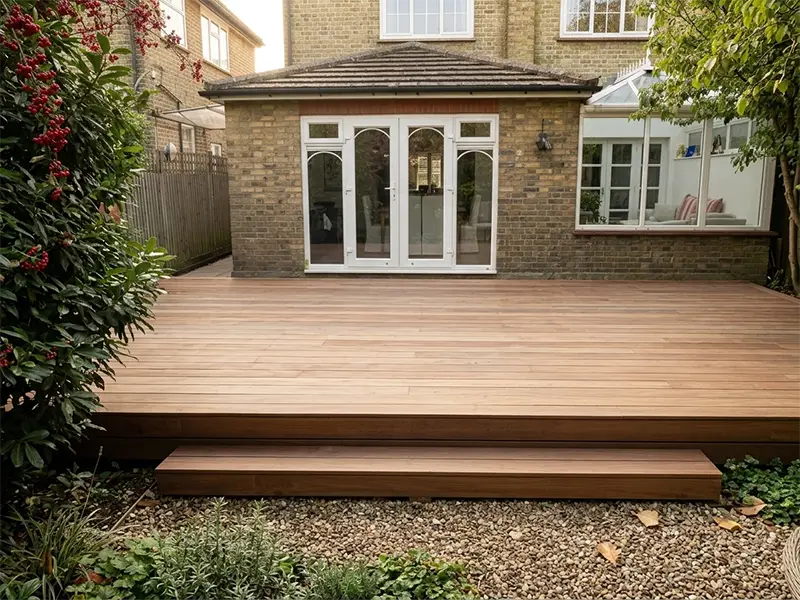
The most easily missed decking costs are removing the old structure, preparing the ground, building suitable supports, getting materials in and waste out, and completing the edges and steps. VAT, professional fees and ongoing care can also sit outside an initial figure.
Not every extra is an unfair charge. Some work is excluded from a basic quote; some depends on a choice you have not made; some genuinely cannot be assessed until an old deck is lifted. For DIY, the same gaps appear between a basket of boards and everything needed to finish. The useful question is: which costs are fixed, which are allowances, and which are still unknown?
What might be missing from the quote?
| Cost area | What can add to it | Ask before booking |
|---|---|---|
| Removal and disposal | Old boards, frame, concrete and excavated soil | Does the price include dismantling, carrying out and disposal of everything being removed? |
| Groundwork and supports | Soft ground, old foundations, drainage and extra support | What ground conditions does your price assume, and what remains uninspected? |
| Access and delivery | Carrying through the house, parking and multiple deliveries | Have you priced the actual route from the delivery vehicle to the garden? |
| Finishing details | Steps, fascia, edges, guarding and access hatches | Can these be shown on the drawing and itemised in the quote? |
| Permissions and specialists | Applications, drawings, structural advice or electrical work | Who arranges these, and whose price includes them? |
| Tax and aftercare | VAT where applicable, first treatment and future upkeep | What is the total payable, and what care will this exact product need? |
1. Taking out the old deck and disposing of it
“Remove existing decking” needs a definition. It might mean lifting the boards, or it might include the frame, posts, concrete supports and everything underneath. Those are different jobs. Ask whether labour, loading, transport and disposal are all included, and whether the waste allowance covers soil or rubble as well as timber.
For a London terrace, carrying dismantled timber through the house may take longer than the demolition itself. Confirm floor protection and clearing up. If a skip is proposed, establish where it will stand and whether parking arrangements add a cost. A skip on a public road requires a permit; one entirely on private land does not need that skip licence. GOV.UK explains the skip permit rules. Ask who organises and pays for it.
2. Groundwork and the frame you cannot see
A price based on clear, firm, accessible ground may change if excavation reveals old concrete, buried rubble or unsuitable ground. Persistent water beneath an existing deck also needs investigation. Simply hiding it under new boards leaves the cause unresolved.
Ask the contractor to record what they inspected and what their price assumes. For a replacement, does it include a complete new subframe, or assume the existing one can be reused? If reuse is proposed, ask how its condition and suitability for the new boards will be assessed. An attractive board price tells you little about the cost of the supporting structure.
Useful wording to request: “Please identify any ground or structural work that is excluded, what would trigger an extra charge, and how that work would be priced.” Photographs and a revised written price should support a proposed change before you approve it.
3. Access, deliveries and protecting your home
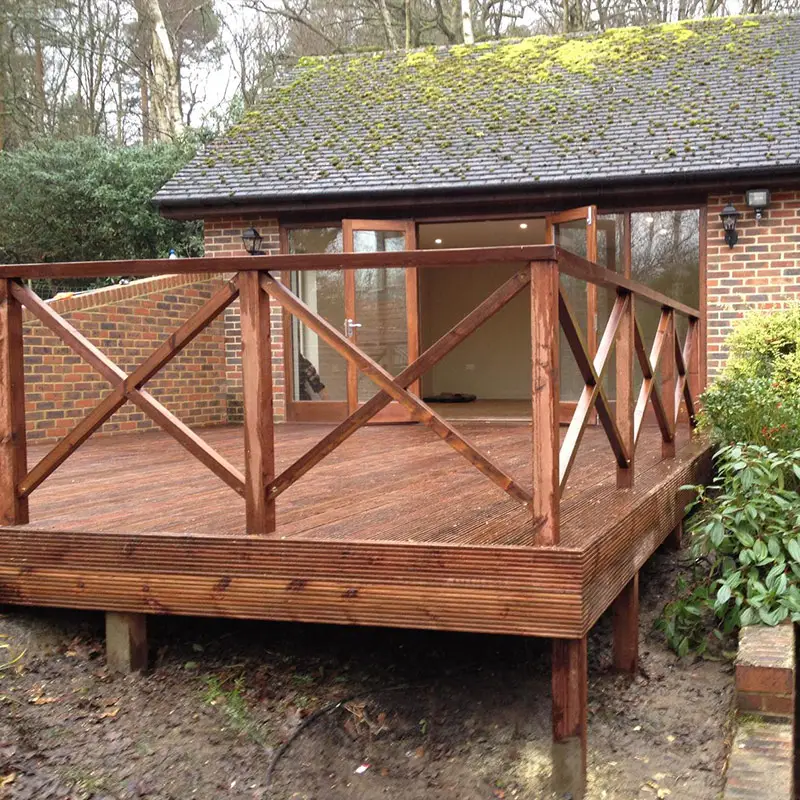
A wide driveway and side gate create a different job from a garden reached through a hallway. Tell the contractor about narrow turns, stairs, restricted delivery hours and limited storage before the survey. Long boards may need a different delivery or handling plan from short samples.
Ask whether the quote covers delivery charges, unloading, carrying materials to the work area, parking arrangements and protection for floors and doors. Where space is tight, more frequent smaller deliveries can add cost. Agree who checks the route rather than discovering a problem when the vehicle arrives.
4. Steps, edges and the details that finish the deck
A square-metre price may describe the flat platform only. Steps, balustrades, fascia boards, picture-frame borders and removable access panels involve extra material and labour. Confirm how the deck meets doors, paths and planting, and how access to existing inspection covers will be retained.
Ask for these features on a simple dimensioned plan. “One step” is not a complete specification: its width and position affect the quantity of material and support required. Mention lighting or sockets early so any separately priced electrical work can be coordinated before the boards go down.
5. Board quantities, fixings and finishing
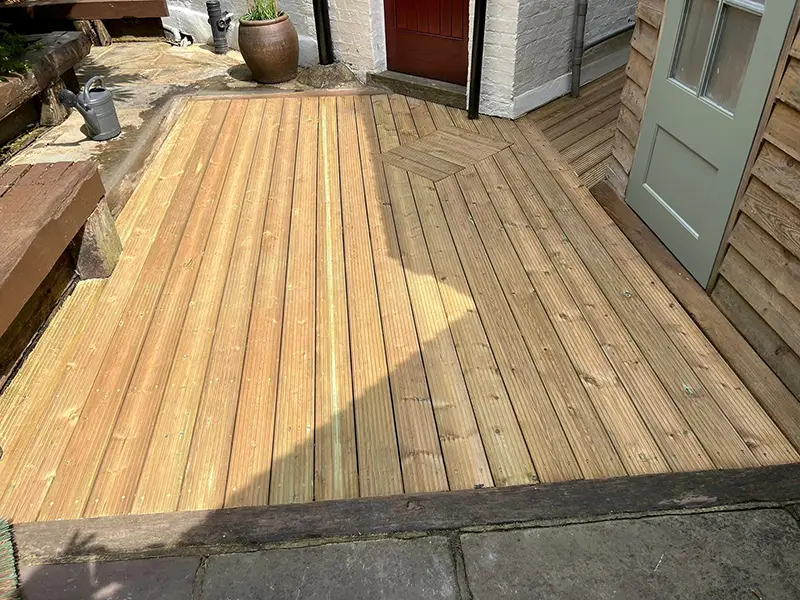
The deck area is not the same as the quantity of boards you need to buy. Available board lengths, offcuts, borders and the laying pattern all affect the cutting plan. Ask whether the material allowance includes that waste and the correct clips, screws, trims and other specified components. Avoid applying an arbitrary waste percentage to every layout.
If timber needs an initial finish, establish whether preparation, the product and application are included, and when it should be applied for that timber and finish. For composite, compare the named range and profile, not just the word “composite”. Different systems can need different supporting details.
6. Permissions, design and specialist advice
Where needed, applications, drawings and structural advice belong in the budget. Do not assume that paying an installer includes these services. Ask separately about planning, building regulations and any property-specific permissions, and agree who checks and arranges them.
Planning Portal sets out conditions for decking under permitted development in England and explains that the householder allowances do not apply to flats. Height alone does not settle every case. Check its decking guidance and, if unclear, your local planning authority before ordering materials. Our London planning guide gives further context.
7. VAT, later changes and ongoing care
Compare the total you will actually pay, including VAT where applicable. Check the quote validity period and whether any material prices remain provisional. If you change the board range, layout or specification after ordering, establish the cost of extra labour, replacement materials and any returns before agreeing.
Upkeep is a separate household cost, rather than necessarily an extra installation charge. Timber may need periodic treatment; composite still needs cleaning. Ask for the chosen product’s care instructions and consider whether you will do the work or pay someone. A board warranty should not be treated as a promise of free maintenance or free replacement labour.
Building it yourself? Budget beyond the boards
DIY can reduce the labour you pay for, but it does not remove the cost of the frame, supports, fixings, delivery or waste. Compare a complete shopping and hire list with a complete installation quote. A supplier’s board-only price is not the cost of a finished DIY deck.
Tools, hire periods and the small consumables
List what you already own, what you can borrow and what you must buy or hire. Depending on the design, this may include a suitable saw, drill or driver, measuring and levelling tools, clamps, digging equipment and protective equipment. Add blades, drill bits and the specified fasteners. Check delivery, collection and any consumable charges on hired equipment, not just the daily headline rate.
Sequence the job before booking hire. If ground preparation takes longer than expected, a tool booked for the next stage may sit unused while the hire clock runs. Compare the total hire period you can realistically achieve with the cost of buying; a weekend rate is only a saving if you can finish in that weekend.
A cutting plan, not just a square-metre calculation
Draw the layout and check it against the supplier’s actual board lengths before ordering. For example, if a design requires 4.2m continuous runs but the chosen boards are 3.6m long, you need a different length, a revised layout or a properly supported joint arrangement. Buying more 3.6m boards does not solve that detail by itself.
Include offcuts and a realistic allowance for mistakes based on the layout and your experience. Check returns before buying: cut boards may not be returnable, and a second delivery for a few missing components can erase a small online saving. Follow the chosen system’s installation instructions when calculating supports and fixings.
Getting materials in and waste out
Ask where the delivery will be unloaded. Kerbside delivery does not mean the driver will carry boards into your back garden. Plan safe handling, dry storage where required and help for items you cannot move safely alone. Confirm the waste route too: check whether your local recycling centre accepts the material and quantity, any booking or vehicle restrictions, and any charges before relying on a free trip.
Your time and the point where you need help
Estimate the whole job: measuring, ordering, collection, clearance, ground preparation, construction, finishing and clean-up. Then allow for weather and rework. Your own time and annual leave have value even when no cash changes hands. Lost earnings, extra childcare and additional tool hire can increase the cash cost. Keep these separate so you can judge the trade-off honestly.
Price any specialist input before starting. Raised structures, difficult ground, heavy loads and electrical additions may require expertise beyond an ordinary DIY project. If you expect an installer to finish your work, speak to them first: do not assume they will accept or guarantee a frame they did not build. They may need inspection, alterations or a rebuild before taking responsibility.
Worked example: when the cheaper quote costs more
These invented figures show the comparison method only. They are not typical prices, an estimate for your garden or a London Decking Specialists quotation. Assume the same deck size, specification and workmanship, with all figures on the same VAT-inclusive basis where applicable.
| Item | Quote A | Quote B |
|---|---|---|
| Initial quote | £6,000 | £7,200 |
| Removal and waste | £650 extra | Included |
| Access and delivery | £250 extra | Included |
| Agreed steps and fascia | £500 extra | Included |
| Comparable total | £7,400 | £7,200 |
Quote A initially appears £1,200 cheaper. Once the agreed scope matches, it is £200 more expensive. Ground conditions are still an unknown in this example: neither total settles that risk. An item marked “TBC” needs a price or an allowance; it should never be entered as £0 in your comparison.
How much contingency should you keep?
For DIY and installed decks alike, there is no single percentage that makes every project safe to budget. A surveyed, accessible site with a fixed design has different unknowns from an old raised deck that has not yet been opened up. First list the unresolved items and ask what investigation could reduce each uncertainty.
Separate three amounts: the agreed contract price, allowances already included in that price, and your own reserve for genuine unforeseen work. If a £600 included allowance becomes £900 for exactly the same scope, the additional amount is £300, not £900. Confirm how unused allowances are credited and whether any extra labour or fees sit outside them.
Your contingency is not automatic permission for the contractor to spend it. Agree a process for describing a problem, pricing the solution and obtaining written approval, including any effect on the completion date.
Where can you save without creating another problem?
Start with the layout: a simpler shape, fewer level changes and dimensions that suit the available board lengths can reduce cutting and complexity. Decide on borders, lighting and built-in seating before pricing; optional features can be priced separately so you can choose deliberately.
Do not remove necessary supports, drainage provisions, safe guarding or the fixings specified for the system to hit a budget. Ask for a smaller or simpler deck with a suitable structure instead. Only undertake clearance yourself if the contractor agrees exactly what you will remove and when the site must be ready.
Before placing a DIY order
- Finish the dimensioned layout and check board lengths, joints and supports against the product instructions.
- List every component, tool and consumable; mark what you own, need to hire or need to buy.
- Confirm the delivery point, handling help, storage, returns and waste arrangements.
- Check permissions and arrange any specialist design or electrical input.
- Write a realistic sequence and time allowance, with a separate reserve for mistakes and unknown ground conditions.
For the wider hiring conversation, use our questions to ask a deck contractor. Bring the same scope to each contractor so their totals can be compared fairly.
Planning a new deck or full replacement?
London Decking Specialists provides new installations and full decking replacements. For an ageing deck, the assessment should consider why it has deteriorated and what the complete replacement needs. Arrange a free, no-obligation quote and discuss the scope, access and any uncertainties before committing.